BMP

BES-TEX Supply, LLC
325.653.1300
BES-TEX Best Management Practices · Lawn Basics
Lawn Care 101
The MWF Method · Mowing, Watering, Feeding
What Is MWF?
For over 20 years, we’ve taught lawn care basics using MWF, because most people already think of that as Monday, Wednesday, Friday.
If you can remember MWF, you can remember the basics of growing grass and reducing weed pressure.
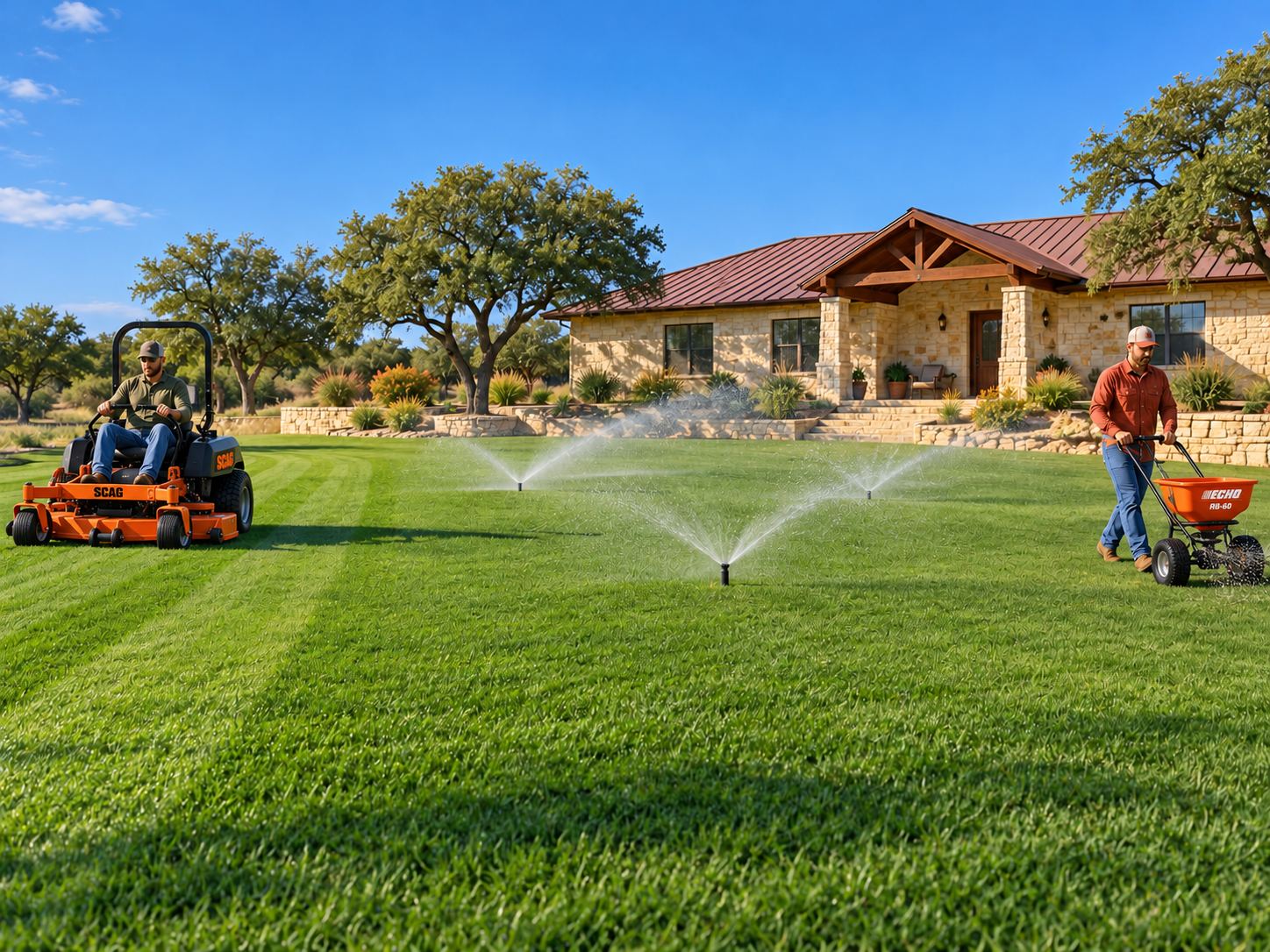
Mowing
Grass grows from the shoot, not the root. The more you mow, the more the grass thickens.
Mow often
Ideally Monday, Wednesday, and Friday.
Sharp blade
Dull blades tear grass, creating stress and disease entry points.
Every 50 hours
Sharpen blades every 50 hours of run time.
Recommended Mowing Heights
St. Augustine
3–4 in
Zoysia
2–3 in
Common Bermuda
2–3 in
TifTuf / Tif 419 Bermuda
1–2 in
Preferred: 1 in · Max: 2 in
Correct height + frequent mowing = thicker turf and fewer weeds.
Watering
The goal of irrigation is to saturate the soil profile to about 6 inches, then allow it to dry back out.
In our clay loam soils
of soil penetration
Keeping soil saturated too long leads to
Irrigation Check
Do this regularly.
Irrigation Audit
1–2 times per year, spring and fall.
Example
½ inch in 15 minutes = 30 minutes total to apply 1 inch
Water deep, then let it dry. More water is not better.
Feeding (Fertilizing)
Grass should be fed when it is actively growing, not when it is dormant.
Every 4–5 weeks
During the growing season. Not year-round.
Balanced fertilizer
A common example we use is 16-8-8.
Skip weed-and-feed
Avoid weed-and-feed products.
Weed and feed products try to kill weeds and grow grass at the same time. Those two goals rarely happen on the same day.
Understanding the Numbers (N-P-K)
Easy way to remember: Up – Down – Out
Nitrogen · Up
Top growth and color
Phosphorus · Down
Root development
Potassium · Out
Strength, stress tolerance, and spread
Why Lawn Care 101 Matters for Weed Control
Most weed problems are not caused by lack of chemicals. They are caused by:
Infrequent mowing
Poor irrigation habits
Compacted soil
Weak, thin turf
Fix MWF First.
Chemicals work better when the basics are right.


What Pre-Emergent Does
Pre-emergent herbicides are used to prevent weeds before they emerge. They work by creating a chemical barrier in the soil that stops newly germinating weed seeds from establishing roots. Pre-emergents do not kill existing weeds. Once a weed is visible, post-emergent control is required.
Pre-emergents must be watered into the soil to activate. Without rainfall or irrigation, the barrier never forms and the application fails. This is why pre-emergents are often called “yellow herbicides” they go down first, quietly do the work underground, and only succeed if moisture moves them into the soil profile.
Timing Matters More Than Product
In West Texas, timing is driven by soil temperature, not the calendar. That said, for simplicity and consistency, our recommended application windows are:
-
February spring pre-emergent
-
May late spring / extended control
-
September fall pre-emergent
These windows line up with weed germination patterns and turf growth in our area.
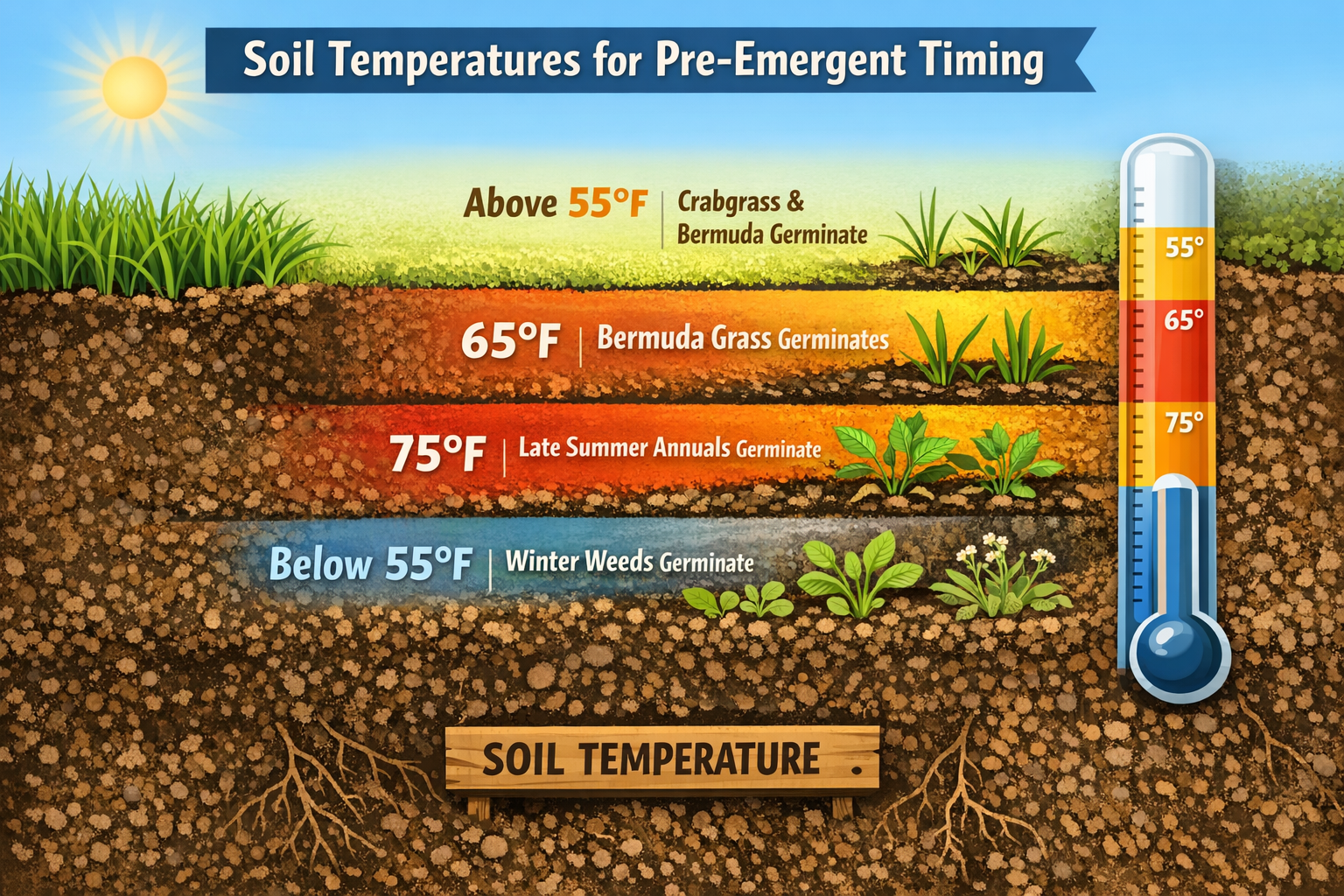
Soil Temperature & Weed Germination
Below 55°F
-
Winter annual weeds germinate
-
Examples: henbit, chickweed, annual bluegrass
Above 55°F
-
Summer annual weeds begin germination
-
Examples: crabgrass, goosegrass
Around 65°F
-
Bermuda grass begins active growth and germination
Above 75°F
-
Late summer annual weeds germinate
-
Heavier pressure and faster growth
Think of soil temperature as a switch. Once that switch flips, the pre-emergent window is closing or already closed.
One Key Reminder
Pre-emergent applications must be watered in with rainfall or irrigation. No water means no barrier. No barrier means weeds.
GRANULAR PRE-EMERGENT PRODUCTS
Andersons 11-3-11 w/ 0.86% Pendimethalin
-
Form: Granular fertilizer + herbicide
-
Rate: 5 lb per 1,000 sq ft
-
Coverage: 10,000 sq ft per 50 lb bag
-
Timing: Spring and fall
-
Strength: Broad annual grass control
-
Notes: Most popular all-around turf program
Pendimethalin 2G
-
Form: Granular herbicide only
-
Rate: 3 lb per 1,000 sq ft
-
Coverage: 13,000 sq ft per 40 lb bag
-
Timing: Spring and fall
-
Strength: Clean pre without fertilizer
-
Notes: Use when fertility is not needed
6-3-12 w/ 0.37% Prodiamine
-
Form: Granular fertilizer + herbicide
-
Carrier: Hu-Actinite
-
Rate: 6.25 lb per 1,000 sq ft
-
Coverage: 8,000 sq ft per bag
-
Timing: Early spring or fall
-
Strength: Long residual control
-
Notes: Stronger hold than pendimethalin
LIQUID PRE-EMERGENT PRODUCTS
Prodiamine 65 WDG (Quali-Pro)
-
Form: Water-dispersible granule
-
Rate:
-
0.38 oz per 1,000 sq ft (lighter pressure)
-
0.55 oz per 1,000 sq ft (heavy pressure)
-
-
Timing: Early spring or fall
-
Strength: Longest residual
-
Notes: Commercial backbone product
Pendimethalin HydroCap
-
Form: Liquid micro-encapsulated
-
Rate:
-
0.55–1.1 oz per 1,000 sq ft
-
-
Timing: Spring or fall
-
Strength: Consistent soil binding
-
Notes: Good alternative to granular programs
PROFESSIONAL-GRADE ADDITIONS
Barricade 4FL (Prodiamine)
-
Form: Liquid
-
Rate: 0.38 - 0.55 oz per 1,000 sq ft
-
Use: Large acreage, commercial turf
-
Strength: Long residual, flexible application
Dimension (Dithiopyr)
-
Form: Granular or liquid
-
Rate: Per formulation
-
Use: Slightly late applications
-
Strength: Early post-emergent activity on crabgrass
-
Notes: Shorter residual than prodiamine
Indaziflam (Esplanade / Specticle)
-
Form: Liquid or granular
-
Rate: Extremely low use rates (label specific)
-
Use: High-pressure commercial sites
-
Strength: Longest residual available
-
Notes: Not for casual homeowner use
Activation & Irrigation
-
Apply ½ - 1 inch of water within 7 - 10 days.
-
Rainfall can substitute if sufficient.
-
Do not mechanically disturb soil after application.
Common Mistakes
-
Applying after weeds are visible.
-
Skipping irrigation.
-
Using pre-emergent on newly seeded turf.
-
Overlapping applications causing root pruning.
Product: Agita 10 WG (thiamethoxam 10%) fly bait/insecticide
Application rate (from EPA & manufacturer label):
-
Mixing: 2.5 oz (75 g) Agita 10 WG in 20 oz (0.6 L) warm water. Stir until dissolved.
-
Coverage: This makes enough for about 2,125 sq ft of treated surface in spot applications.
-
Spot treatment: Paint or spray only about 30% of available surfaces where flies rest, sunny walls, around windows, door frames, and rafters.
-
Reapply: Every 4 - 6 weeks or sooner if treated areas are washed or heavily soiled.
Time of day for best results:
-
Apply early morning or late afternoon when flies are active but not in the peak midday heat (over ~95°F, flies often rest in shaded areas).
-
Morning applications let the bait dry before flies peak in activity, which usually occurs mid to late morning.
Longevity / Residual control:
-
Indoors: up to 6 weeks residual kill if surfaces remain dry and clean.
-
Outdoors: typically 2 - 4 weeks, shorter if rain, high humidity, or dust build-up occurs.
-
Flies begin dying within minutes to hours after contact/feeding.
Extra BMP tips:
-
Rotate with non–Group 4A products every season to reduce resistance risk.
-
Don’t apply to areas where animals can lick or touch it.
-
Avoid use where food/feed could be contaminated.
Mixing Instructions for One Acre Application
Using Esplanade 200 SC, Ranger Pro, and Diquat
- Product Rates per Acre
- Esplanade 200 SC (Pre-emergent): 5 to 7 fluid ounces
- Ranger Pro (41% Glyphosate): 2 to 3 quarts
- Diquat (37.3%): 1 to 2 quarts
- Example Mix for One Acre
- Esplanade 200 SC 6 oz
- Ranger Pro 2.5 quarts (80 oz)
- Diquat 1.5 quarts (48 oz)
- Mix into 40 to 80 gallons of water, depending on your sprayer output
- Coverage
- One acre = 43,560 square feet
- Typical application volume = 1 to 2 gallons per 1,000 sq ft
- That means you'll use 44 to 87 gallons of finished spray per acre
Fence Row Application
If spraying a fence row, measure 1 foot out on each side of the fence.
This creates a 2-foot wide band along the fence.
To calculate product needs:
- 1 mile of fence row (2 feet wide) = 0.24 acres
- Adjust your chemical mix based on this portion of an acre
- Example: Use about 1.5 oz Esplanade, 0.6 qt Ranger Pro, and 0.4 qt Diquat for 1 mile
Make sure to agitate the tank mix during application.
Spray evenly and avoid overlap for best results.
Let us know how we can help. We’re here to serve.
BES-TEX Supply • 4512 Adobe Dr. • San Angelo, TX 76903 • 325.653.1300 • www.BES-TEX.com
Here’s a complete and organized list of 20 each for Broadleaf, Grassy, and Sedge-type weeds, divided by summer and winter, common to Texas lawns:
Broadleaf Weeds in Texas
Summer Broadleaf Weeds (Warm-Season)
- Virginia Buttonweed
- Spurge (Prostrate & Spotted)
- Purslane
- Pigweed
- Carpetweed
- Ground Ivy
- Curly Dock
- Black Medic
- Burweed (stickerweed) – late spring
- Common Ragweed
Winter Broadleaf Weeds (Cool-Season)
- Henbit
- Chickweed
- Dandelion
- Clover
- Mallow
- Hairy Bittercress
- Wild Violets
- Shepherd’s Purse
- Thistle
- Deadnettle
Grassy Weeds in Texas
Summer Grassy Weeds (Warm-Season)
- Crabgrass
- Goosegrass
- Dallisgrass (perennial)
- Johnsongrass (perennial)
- Barnyardgrass
- Texas Panicum
- Sandbur
- Smutsgrass
- Foxtail (Setaria spp.)
- Crowfootgrass
- Liverseed Grass (Urochloa panicoides)
- Lovegrass
- Vaseygrass
- Sprangletop
- Carpetgrass (invasive in Bermuda/St. Aug.)
- Field Sandbur
- Signalgrass
- Itchgrass
- Woolly Cupgrass
- Junglerice (Echinochloa colona)
Winter Grassy Weeds (Cool-Season)
- Annual Bluegrass (Poa annua)
- Rescuegrass
- Ryegrass
- Cheatgrass
- Little Barley
- Downy Brome
- Tall Fescue (volunteer clumps)
- Wild Oats
- Canarygrass
- Volunteer wheat
- Volunteer oats
- Bromegrass
- Medusahead
- Jointed Goatgrass
- Rat-tail Fescue
- Soft Chess
- Roughstalk Bluegrass
- Slender Wildrye
- Velvetgrass
- Italian Ryegrass
Sedge and Sedge-Like Weeds (Warm-Season)
Most sedges are warm-season and thrive in wet, compacted soil.
- Yellow Nutsedge
- Purple Nutsedge
- Green Kyllinga