BMP
How much mulch do I need?
All mulch bags: 2 cubic feet. Pallet breakdown uses 65 bags per pallet.
Pallet coverage comes from your selected variety. Minimum order: 1 pallet. Quantities round up to whole pallets.
Compost topdressing: 1 cubic yard per 1,000 square feet.
My mulch project


BES-TEX Supply, LLC
325.653.1300
BES-TEX Best Management Practices · Weed Control
Pre-Emergent Herbicides for Lawns
Stop weeds before they start
A pre-emergent works before weeds come up. Here’s how to get the most from it.
8 Steps to Better Weed Prevention
What Pre-Emergent Does
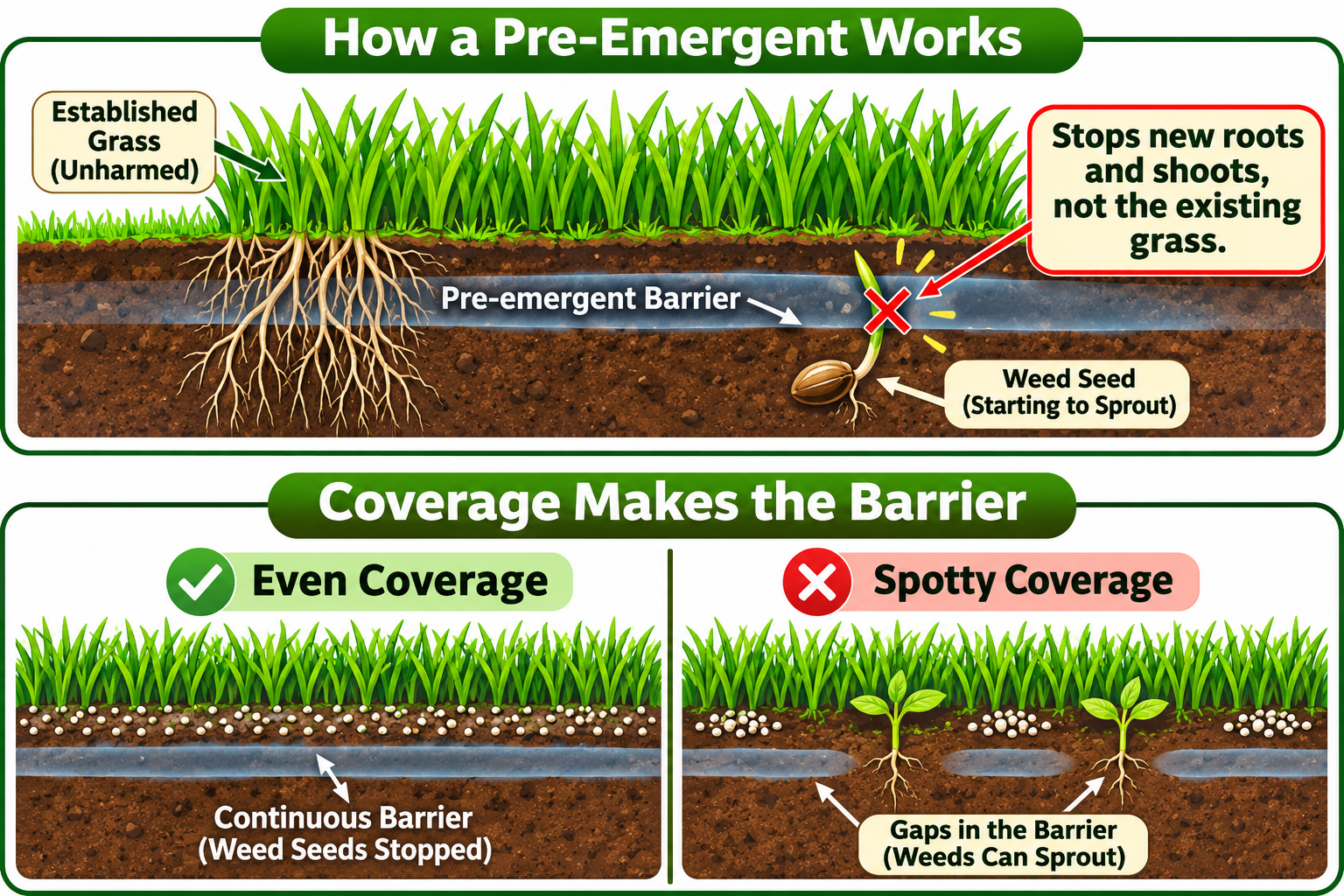
A pre-emergent prevents weed seeds from germinating.
It does not kill the existing plant. It stops the new root and first leaves of a germinating weed seed. That is why it is so important to get the pre-emergent into the soil, where it forms a barrier.
It won’t kill weeds you can already see. For those, see our post-emergent guides, like our Bermuda post-emergent guide.
Timing
Timing matters more than anything.
Apply before weed seeds germinate.
Simple rule: apply in the first of February, the first of May, and the first of September.
Even Coverage Matters
Apply it evenly across the whole lawn.
Smaller Particles Work Better
The smaller the particle, the better it works.
Granular vs. Liquid
Pre-emergent comes in granular and liquid forms.
Which one you use depends on the application tools you have. Homeowners typically use a granular product. Liquid is the other option.
With liquid, pros can cover more square feet per tank, but it must be watered in with as much water as possible. A pump-up sprayer doesn’t do a very good job unless you can water it in with your irrigation system or an extra hose.
Split Applications
Split applications extend how long you’re covered.
In the springtime, split applications are typically spaced 30 days apart.
Water It In
Pre-emergent has to be watered in after application.
Don’t Disturb the Soil Surface
Don’t disturb the soil surface after application.
Works the same on every lawn. A pre-emergent doesn’t pick and choose. It stops any germinating seed, whether it was dropped by a bird, spread by you, or carried in by the wind. That means there are no turf-specific differences for pre-emergent, unlike post-emergent, where your turf type matters.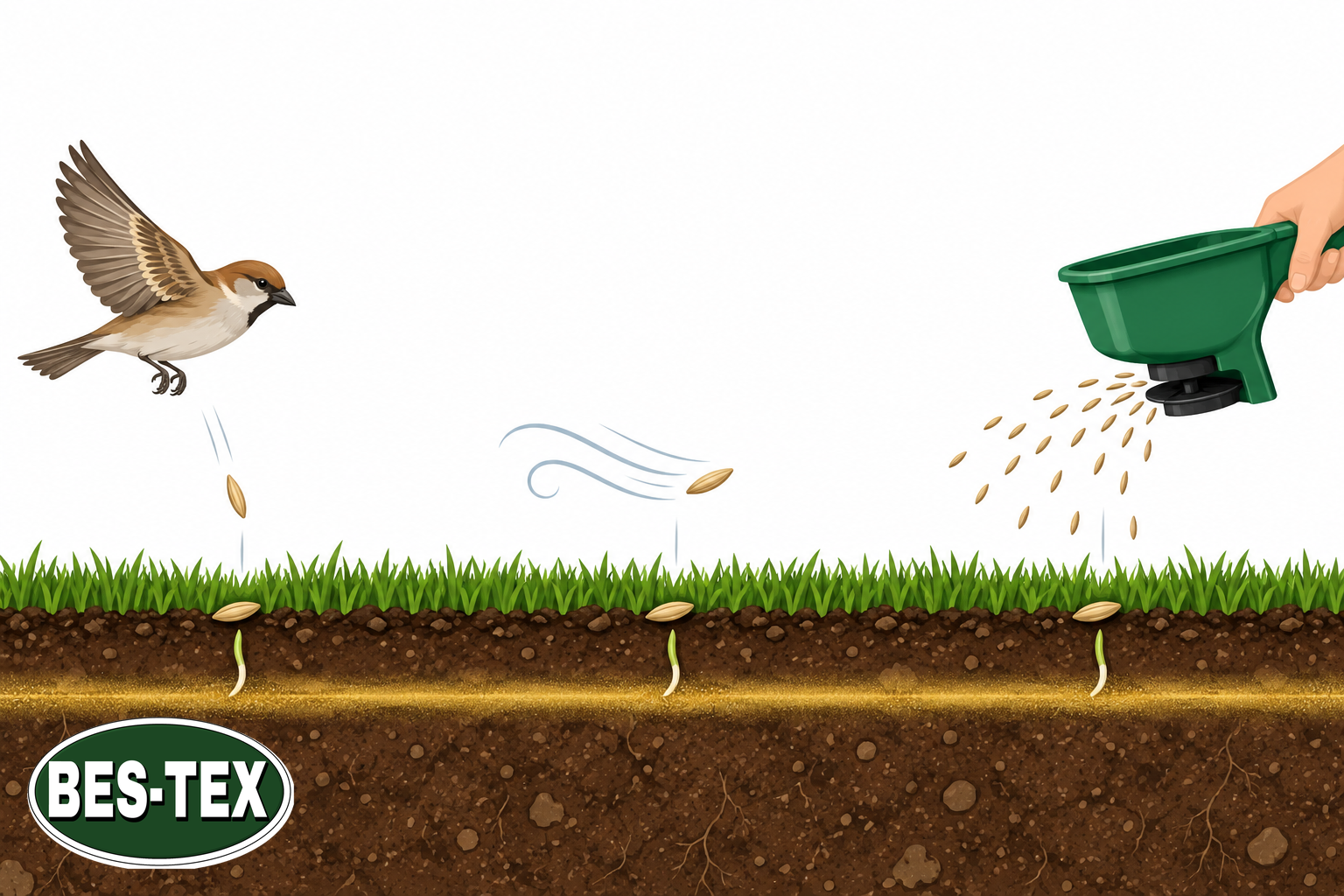
Need Help With Your Weeds?
Stop by BES-TEX or give us a call. We’re glad to help you pick the right product and get it on right.
BES-TEX Supply, LLC
325.653.1300
BES-TEX Best Management Practices · Weed Control
Post-Emergent Herbicides for Zoysia Lawns
For Zoysia lawns only · Broadleaf weeds you can see now
You’ve used the broadleaf weed ID guide to identify the weed in your Zoysia lawn (including its germination and seed timing), and you’ve confirmed it’s visible now.
Here’s how to treat it.
Section 1
Broadleaf Weeds in Zoysia
8 Steps to Better Broadleaf Control
Selective vs. Non-Selective
Selective herbicides kill broadleaf weeds and leave your Zoysia alone.
Non-selective herbicides kill everything they touch, including your grass.
Mode of Action
Mode of action is how the chemical moves through the plant.
Treat Weeds While They’re Young
Spray weeds while they are young and tender, not after they are mature. Young weeds are much easier to control.
Mixing a One-Gallon Sprayer
- Add a half gallon of fresh, good-quality water first.
- Add the exact herbicide dose listed on the label.
- Put the lid on and shake well.
- Add the remaining water.
Always Add a Surfactant
A surfactant breaks the surface tension of water. That lets the spray spread out across the leaf instead of beading up and rolling off.
Spraying Technique
Hold the wand 12 to 18 inches off the ground and aim for about an 8-inch, dinner-plate-sized spray pattern.
Spray in the Morning
Spray in the morning, not the afternoon. At dawn the plant is drinking from its roots, which helps pull the herbicide into the plant.
Don’t Mow Right Before Spraying
Mow Saturday, spray Wednesday.
The goal is maximum leaf tissue on the plant, and keeping the herbicide on the plant as long as possible before the next mow.
Then return to your regular MWF (Mow, Water, Feed) routine and mow again.
Mow Zoysia at 2–3 inches.
[PLACEHOLDER: Zoysia-specific differences / grassy weeds, Monte to provide]
Need Help With Your Weeds?
Stop by BES-TEX or give us a call. We’re glad to help you pick the right product and get it on right.
BES-TEX Supply, LLC
325.653.1300
BES-TEX Best Management Practices · Weed Control
Post-Emergent Herbicides for St. Augustine Lawns
For St. Augustine lawns only · Broadleaf weeds you can see now
You’ve used the broadleaf weed ID guide to identify the weed in your St. Augustine lawn (including its germination and seed timing), and you’ve confirmed it’s visible now.
Here’s how to treat it.
Section 1
Broadleaf Weeds in St. Augustine
8 Steps to Better Broadleaf Control
Selective vs. Non-Selective
Selective herbicides kill broadleaf weeds and leave your St. Augustine alone.
Non-selective herbicides kill everything they touch, including your grass.
Mode of Action
Mode of action is how the chemical moves through the plant.
Treat Weeds While They’re Young
Spray weeds while they are young and tender, not after they are mature. Young weeds are much easier to control.
Mixing a One-Gallon Sprayer
- Add a half gallon of fresh, good-quality water first.
- Add the exact herbicide dose listed on the label.
- Put the lid on and shake well.
- Add the remaining water.
Always Add a Surfactant
A surfactant breaks the surface tension of water. That lets the spray spread out across the leaf instead of beading up and rolling off.
Spraying Technique
Hold the wand 12 to 18 inches off the ground and aim for about an 8-inch, dinner-plate-sized spray pattern.
Spray in the Morning
Spray in the morning, not the afternoon. At dawn the plant is drinking from its roots, which helps pull the herbicide into the plant.
Don’t Mow Right Before Spraying
Mow Saturday, spray Wednesday.
The goal is maximum leaf tissue on the plant, and keeping the herbicide on the plant as long as possible before the next mow.
Then return to your regular MWF (Mow, Water, Feed) routine and mow again.
Mow St. Augustine at 3–4 inches.
[PLACEHOLDER: St. Augustine-specific differences / grassy weeds, Monte to provide]
Need Help With Your Weeds?
Stop by BES-TEX or give us a call. We’re glad to help you pick the right product and get it on right.
BES-TEX Supply, LLC
325.653.1300
BES-TEX Best Management Practices · Weed Control
Post-Emergent Herbicides for Bermuda Lawns
For Bermuda lawns only · Broadleaf and grassy weeds you can see now
You’ve used the broadleaf weed ID guide to identify the weed in your Bermuda lawn (including its germination and seed timing), and you’ve confirmed it’s visible now.
Here’s how to treat it.
Section 1
Broadleaf Weeds in Bermuda
8 Steps to Better Broadleaf Control
Selective vs. Non-Selective
Selective herbicides kill broadleaf weeds and leave your Bermuda alone.
Non-selective herbicides kill everything they touch, including your grass.
Mode of Action
Mode of action is how the chemical moves through the plant.
Treat Weeds While They’re Young
Spray weeds while they are young and tender, not after they are mature. Young weeds are much easier to control.
Mixing a One-Gallon Sprayer
- Add a half gallon of fresh, good-quality water first.
- Add the exact herbicide dose listed on the label.
- Put the lid on and shake well.
- Add the remaining water.
Always Add a Surfactant
A surfactant breaks the surface tension of water. That lets the spray spread out across the leaf instead of beading up and rolling off.
Spraying Technique
Hold the wand 12 to 18 inches off the ground and aim for about an 8-inch, dinner-plate-sized spray pattern.
Spray in the Morning
Spray in the morning, not the afternoon. At dawn the plant is drinking from its roots, which helps pull the herbicide into the plant.
Don’t Mow Right Before Spraying
Mow Saturday, spray Wednesday.
The goal is maximum leaf tissue on the plant, and keeping the herbicide on the plant as long as possible before the next mow.
Then return to your regular MWF (Mow, Water, Feed) routine and mow again.
Section 2
Grassy Weeds in Bermuda
Grassy post-emergent herbicides are used to control grassy weeds that are already visible above the soil. They do not prevent weeds and do not replace a pre-emergent program.
What Control Depends On
- Turf species
- Whether the grassy weed is annual or perennial
- Growth stage
- Temperature and turf health
Match the Weed to the Level
- Good: young annual grasses
- Better: mature annual grasses
- Best: perennial grasses and resistant weeds
Correct identification comes before product choice.
Perennial Grasses Take Time
Perennial grassy weeds are not quick fixes. Control takes time, repeat applications, and strong turf competition.
Common Reasons Control Fails
- Waiting too long to spray
- Misidentifying annual vs. perennial grasses
- Skipping adjuvants
- Spraying stressed turf
- Poor mowing and irrigation practices
Need Help With Your Weeds?
Stop by BES-TEX or give us a call. We’re glad to help you pick the right product and get it on right.
BEST MANAGEMENT PRACTICE (BMP)
Root Zone Health, Heat Stress, Water Management & Turf Recovery
A Science-Based Approach to Diagnosing Warm-Season Turf Problems
Prepared for BES-TEX Supply, LLC
San Angelo, Texas
"Healthy turf begins below the surface."
Purpose
Every summer, customers visit BES-TEX with brown spots, thinning turf, or declining bermudagrass. While many assume the problem is a fungus, research and field experience show that environmental stress is often the primary cause.
This BMP is designed to help our staff diagnose the underlying cause before recommending products.
Our objective is simple:
Diagnose the problem first. Recommend products second.
The BES-TEX Philosophy
Grass doesn't read labels.
It responds to its environment.
Healthy turf is built by understanding:
• Soil
• Water
• Roots
• Temperature
• Oxygen
• Nutrition
• Sunlight
Only after understanding these factors should pesticides or specialty products be recommended.
STEP 1
Begin With Questions
Before discussing products, ask:
• What type of grass do you have?
• How long has the problem existed?
• Is it spreading?
• Has anything recently changed?
• Are you using city water or well water?
• Has the lawn been treated recently?
• Have you applied fertilizer?
• Has a fungicide already been used?
• Has an insecticide already been used?
STEP 2
Inspect the Root Zone
Never diagnose a lawn from the leaves alone.
Inspect:
• Root depth
• Root color
• Soil moisture
• Soil temperature
• Soil compaction
• Drainage
• Odor
Healthy roots should be:
• White to cream colored
• Firm
• Numerous
• Deep
Poor roots are often:
• Brown
• Black
• Short
• Rotten
• Easily pulled from the soil
STEP 3
Measure Soil Temperature
Root temperature is one of the most overlooked measurements in turfgrass management.
Approximate guidelines:
Below 90°F
Excellent growing conditions.
90–100°F
Root growth begins slowing.
100–110°F
Moderate heat stress.
110–115°F
Significant root stress.
Above 115°F
Root function may decline rapidly, especially when combined with drought, compaction or poor-quality irrigation water.
Measure soil temperature approximately 2 inches below the surface during the afternoon.
STEP 4
Evaluate Irrigation
Many lawn problems are irrigation problems.
Inspect:
• Sprinkler coverage
• Plugged nozzles
• Pressure problems
• Overspray
• Dry areas
• Wet areas
Perform a catch-can test whenever possible.
Water deeply and infrequently rather than shallow daily watering.
STEP 5
Localized Dry Spot
Localized Dry Spot (LDS) occurs when portions of the soil become water repellent.
Symptoms include:
• Brown patches
• Water running off instead of soaking in
• Turf declining despite irrigation
• Dry soil beneath dead grass
A screwdriver or soil probe can quickly identify dry areas.
STEP 6
Soil Surfactants (Wetting Agents)
Purpose:
Improve water movement into and through the soil profile.
Benefits
• Improves infiltration
• Reduces runoff
• Improves irrigation efficiency
• Reduces localized dry spot
• Encourages deeper rooting
Typical Program
Initial application:
8–16 ounces per 1,000 square feet
Monthly maintenance:
4–8 ounces per 1,000 square feet
Apply in at least 2 gallons of water per 1,000 sq ft and irrigate with approximately ¼ inch of water after application unless applied through the irrigation system. Always follow the product label.
STEP 7
Hydretain®
Purpose
Hydretain is a root-zone moisture management product.
Unlike a wetting agent, Hydretain helps plants utilize existing soil moisture more efficiently.
Benefits
• Delays drought stress
• Improves water-use efficiency
• May reduce irrigation frequency
• Helps turf during periods of extreme heat
Typical Program
Initial application
9 ounces per 1,000 square feet
Monthly maintenance
3 ounces per 1,000 square feet
Water into the root zone soon after application according to the label.
Hydretain is NOT
• A wetting agent
• A fungicide
• A fertilizer
• A salt remover
• A replacement for irrigation
STEP 8
Core Aerification
One of the best cultural practices available.
Benefits
• Improves oxygen movement
• Reduces compaction
• Improves infiltration
• Encourages deeper roots
• Improves fertilizer movement
• Improves overall soil health
STEP 9
Organic Matter
Many West Texas soils contain less than 1% organic matter.
Low organic matter contributes to:
• Faster drying
• Reduced microbial activity
• Increased heat stress
• Reduced water-holding capacity
• Poor root development
Increasing organic matter improves overall soil performance.
STEP 10
Irrigation Water Quality
When using well water, a water analysis is highly recommended.
Important measurements include:
Electrical Conductivity (EC)
EC measures the total concentration of dissolved salts in irrigation water.
Higher EC means more dissolved salts.
High EC can:
• Reduce water uptake
• Increase drought stress
• Contribute to salt accumulation
Think of EC as:
"How salty is the water?"
Sodium Adsorption Ratio (SAR)
SAR measures the amount of sodium relative to calcium and magnesium.
High SAR can:
• Destroy soil structure
• Reduce infiltration
• Reduce oxygen
• Increase runoff
• Increase compaction
Think of SAR as:
"How damaging is the sodium to the soil?"
Both EC and SAR should always be evaluated together.
STEP 11
Fertility
Base fertilizer recommendations on a soil test.
Avoid excessive nitrogen during periods of extreme summer heat.
STEP 12
Disease
Many diseases are secondary problems.
Stress weakens turf.
Disease follows.
Always inspect:
• Roots
• Soil moisture
• Irrigation
• Soil temperature
before recommending fungicides.
WHEN NOT TO USE THESE PRODUCTS
Wetting Agents
Do NOT expect wetting agents to:
• Cure disease
• Fix irrigation systems
• Remove salts
• Correct fertility problems
• Eliminate compaction
Hydretain®
Do NOT expect Hydretain to:
• Replace irrigation
• Cure disease
• Remove sodium
• Lower salinity
• Correct drainage
Gypsum
Do NOT recommend gypsum simply because soil pH is high.
Gypsum is most beneficial when testing confirms sodium-related soil problems.
Fungicides
Do NOT recommend fungicides simply because the grass is brown.
Brown grass is a symptom, not a diagnosis.
BES-TEX Diagnostic Order
Before recommending any product, ask:
✓ Is the grass alive?
✓ Are the roots healthy?
✓ Is the soil wet or dry?
✓ What is the soil temperature?
✓ Is irrigation uniform?
✓ Has a wetting agent been used?
✓ Has the lawn been aerified?
✓ Is the irrigation water from a well?
✓ Has the water been tested for EC and SAR?
✓ Is there evidence of insects?
✓ Is there evidence of disease?
Only after answering these questions should a product recommendation be made.
Final Thoughts
At BES-TEX Supply, we believe our responsibility extends beyond selling products. Our goal is to educate customers, identify the true cause of turf problems, and recommend science-based solutions that provide long-term success.
Treat the cause, not just the symptom.
HOW TO USE THIS CHART
-
Identify the weed.
-
Determine weed type (Broadleaf, Grass, Sedge).
-
Match the weed to the chemistry group below.
-
Set expectations based on how the plant dies.
GROUP 4 – SYNTHETIC AUXINS (Growth Hormone Herbicides)
What it does: Mimics plant growth hormones → twisting, curling, vascular collapse.
Type: Systemic
Best on: Broadleaf weeds
Products (Active %):
-
2,4‑D Amine – 2,4‑D 46.8–47.2%
-
Trimec Southern – 2,4‑D 17.37% + Dicamba 3.85%
-
Weed Whacker Jet Spray – 2,4‑D 0.326% + Dichlorprop‑P 0.164% + Mecoprop‑P 0.161%
Notes: Slower visual response unless combined with contact chemistry.
GROUP 14 – PPO INHIBITORS (Cell Membrane Disruptors)
What it does: Ruptures cell membranes → fast leaf burn.
Type: Contact
Best on: Tough broadleaf weeds, some sedges
Products (Active %):
-
Sulfentrazone 4SC – Sulfentrazone (4 lb/gal)
-
Blindside – Sulfentrazone 60% + Metsulfuron‑methyl 6%
-
SpeedZone Southern / Weed Free Zone – Carfentrazone 0.54% (plus Group 4 actives)
Notes: Coverage and spray technique are critical.
GROUP 2 – ALS INHIBITORS (Amino Acid Blockers)
What it does: Stops amino acid production → growth stops first, yellowing later.
Type: Systemic
Best on: Winter annual broadleaf, some grasses, sedges
Products (Active %):
-
MSM Turf – Metsulfuron‑methyl 60%
-
Telar XP – Chlorsulfuron 75%
-
Katana – Flazasulfuron 25%
-
Southpaw – Sulfosulfuron 11.6% + Metsulfuron 3.8% + Dicamba 39.8%
-
Celsius – Thiencarbazone‑methyl 8.7% + Iodosulfuron 1.9% + Dicamba 57.4%
-
Celsius XTRA – Thiencarbazone‑methyl 4.29% + Iodosulfuron 0.93% + Halosulfuron 10%
Notes: Slow visual results. Resistance risk if misused.
GROUP 5 – PHOTOSYSTEM II INHIBITORS
What it does: Blocks photosynthesis → plant starves.
Type: Systemic
Best on: Broadleaf weeds in St. Augustine / Centipede
Products (Active %):
-
Atrazine 4L – Atrazine 42.4–42.9%
-
Atrazine 4% – Atrazine 4%
Notes: Turf‑specific. Always confirm grass type.
GROUP 27 – HPPD INHIBITORS (Bleachers)
What it does: Destroys chlorophyll protection → whitening then death.
Type: Systemic
Best on: Seedling weeds, mixed pressure
Products (Active %):
-
Meso 4SC – Mesotrione 40%
Notes: Bleaching is success, not turf injury.
QUICK MEMORY GUIDE
-
Twist = Group 4
-
Burn = Group 14
-
Stop Growth = Group 2
-
Starve = Group 5
-
Bleach = Group 27
Grassy post-emergent herbicides are used to control grassy weeds that are already visible above the soil. These products do not prevent weeds and do not replace pre-emergent programs.
Correct control depends on:
-
Turf species
-
Whether the grass weed is annual or perennial
-
Growth stage
-
Temperature and turf health
✅ GOOD
Entry-Level Annual Grassy Weed Control
Products
-
Quinclorac 75DF
-
Quintessential (Quinclorac liquid)
-
Q4 Plus (contains quinclorac)
Typical Rate
-
0.75 – 1.5 oz per 1,000 sq ft
(Adjuvant required for best results)
Timing
-
Best on young, actively growing grasses
-
Spring through early summer
-
Air temperatures 65 - 85°F
Turf Sensitivity
-
Bermuda: Safe
-
Zoysia: Safe
-
St. Augustine: Use caution, label dependent
-
Fescue: Label dependent
What GOOD does well
-
Crabgrass
-
Smooth crabgrass
-
Some signalgrass
-
Early goosegrass
Limits
-
Weak on mature plants
-
Weak on perennial grasses
-
Repeat applications often needed
Counter explanation
“This works best when the grass is young. Once it matures, we need to step up.”
✅ BETTER
Workhorse Grassy Weed Control
Products
-
Revolver (Foramsulfuron)
-
Pastora
-
Fusilade II / Fusilade DX
-
Ornamec 170
-
Katana
Typical Rate
-
Revolver: ~0.1 – 0.6 oz per 1,000 sq ft
-
Fluazifop products: label-specific, low rate
-
Pastora / Katana: low-rate, measured carefully
Timing
-
Turf actively growing
-
Best results when weeds are not stressed
-
Morning applications preferred
Turf Sensitivity
-
Bermuda: Excellent tolerance
-
Zoysia: Label dependent
-
St. Augustine:
-
Fluazifop products are NOT labeled
-
Revolver is Bermuda only
-
-
Cool-season turf: Label dependent
Strengths
-
Better control of mature grasses
-
Controls difficult annual grasses
-
Some suppression of perennial grasses
Counter explanation
“This is stronger control for grasses that are past the seedling stage.”
✅ BEST
Professional / Perennial Grassy Weed Control
Products
-
MSMA (Golf Course Only)
-
Certainty
-
Kerb SC (RUP)
-
Telar XP (limited grassy activity)
Typical Rates
-
Certainty: 0.75 – 1.25 grams per 1,000 sq ft
-
MSMA: golf-only, label specific 2 oz per 1000 sq ft 3 applications 7 days apart.
-
Kerb SC: restricted use, temperature critical
Timing
-
Turf must be healthy
-
Often requires multiple applications
-
Timing is critical, especially for perennials
Turf Sensitivity (Very Important)
-
Bermuda: Primary target turf
-
Zoysia: Label dependent
-
St. Augustine: Limited or NOT labeled
-
Fescue: Label dependent
What BEST does well
-
Dallisgrass suppression
-
Johnsongrass suppression
-
Tough perennial grasses
-
Grasses resistant to quinclorac
Important Truth
Perennial grassy weeds are not quick fixes. Control takes time, repeat applications, and strong turf competition.
Counter explanation
“Perennial grasses don’t die easy. This is a program, not a one-spray solution.”
Common Reasons Grassy Weed Control Fails
-
Waiting too long to spray
-
Misidentifying annual vs perennial grasses
-
Skipping adjuvants
-
Spraying stressed turf
-
Poor mowing and irrigation practices
➡ Link: Lawn Care 101 BMP
Summary for Staff
-
GOOD: Young annual grasses
-
BETTER: Mature annual grasses
-
BEST: Perennial grasses and resistant weeds
Correct identification comes before product choice.
Broadleaf post-emergent herbicides are used to control weeds that are already visible above the soil. These products do not prevent weeds, they control existing plants. Correct product selection depends on:
-
Turf type
-
Weed maturity
-
Temperature
-
Application rate
Before You Spray (Always Say This First)
-
If the weed is visible, pre-emergent will not work
-
Turf must be actively growing, not stressed
-
Do not spray drought-stressed or heat-stressed turf
-
Follow the label exactly
GOOD · BETTER · BEST
✅ GOOD
Entry-Level Broadleaf Control
Products
-
2,4-D Amine, One way herbicide
-
3-D Foam (spot treat)
-
Trimec Southern, Three way herbicide
Typical Rate
-
1.0 – 1.5 oz per 1,000 sq ft
Timing and Technique
Post-emergent herbicides work best when applied early in the morning. Morning applications are preferred over afternoon or evening sprays for several reasons:
-
Leaf tissue is dry, allowing better herbicide contact
-
Plants are actively transpiring
-
Leaf pores are more receptive to herbicide uptake
-
Cooler temperatures reduce turf stress and drift
Avoid spraying during the heat of the day or late evening when uptake is reduced and stress is higher.
Spray Technique
Proper technique matters as much as product choice.
-
Keep the spray nozzle 12 -18 inches above the turf
-
Use a medium droplet size, not a fine mist
-
Pattern should be about the size of a dinner plate
-
Apply in a circular motion, not side-to-side
-
Goal is even coverage, not runoff
Over-application does not improve control and increases the risk of turf injury.
Key Reminder
Post-emergent herbicides work through leaf absorption, not the soil. Dry leaves, proper timing, and correct spray pattern are critical for consistent results.
Best practice:
Early morning, dry leaf, correct height, steady circular motion.
-
Spring and fall
-
Air temperatures 60 - 85°F
-
Best on young, actively growing weeds
Turf Sensitivity
-
Bermuda: Safe when actively growing
-
Zoysia: Generally safe, avoid stress
-
St. Augustine: Use caution, amine formulations only
-
Dormant turf: Poor results
Limits
-
Slower results
-
Limited on tough weeds
-
Weak on spurge, mallow, dollarweed
-
No sedge or grassy weed control
Counter explanation
“This works on small, common weeds. If they’re mature or stubborn, we’ll need to step up.”
✅ BETTER
Workhorse Broadleaf Control
Products
-
SpeedZone Southern (RUP)
-
Weed Free Zone
-
Q4 Plus
-
Blindside
-
Basagran T&O
-
Triclopyr (Brush & Stump)
Typical Rate
-
0.75 – 1.25 oz per 1,000 sq ft
(Blindside often lower)
Timing and Technique
Post-emergent herbicides work best when applied early in the morning. Morning applications are preferred over afternoon or evening sprays for several reasons:
-
Leaf tissue is dry, allowing better herbicide contact
-
Plants are actively transpiring
-
Leaf pores are more receptive to herbicide uptake
-
Cooler temperatures reduce turf stress and drift
Avoid spraying during the heat of the day or late evening when uptake is reduced and stress is higher.
Spray Technique
Proper technique matters as much as product choice.
-
Keep the spray nozzle 12 -18 inches above the turf
-
Use a medium droplet size, not a fine mist
-
Pattern should be about the size of a dinner plate
-
Apply in a circular motion, not side-to-side
-
Goal is even coverage, not runoff
Over-application does not improve control and increases the risk of turf injury.
Key Reminder
Post-emergent herbicides work through leaf absorption, not the soil. Dry leaves, proper timing, and correct spray pattern are critical for consistent results.
-
Spring through early summer
-
Fall clean-up
-
Faster visual burn-down than GOOD products
Turf Sensitivity
-
Bermuda: Safe when actively growing
-
Zoysia: Safe at label rates
-
St. Augustine:
-
Use Southern-labeled products only
-
Avoid ester formulations during heat
-
-
Heat caution:
-
Ester products above 85 - 90°F can cause injury
-
Strengths
-
Faster knockdown
-
Broader weed spectrum
-
Better on spurge, mallow, dollarweed
-
Triclopyr adds woody and vine control
Counter explanation
“This gives quicker results and handles tougher weeds without jumping to specialty products.”
✅ BEST
Professional / Advanced Control
Products
-
Celsius
-
Celsius XTRA
-
MSM Turf
-
Southpaw
-
Telar XP
-
Katana
-
Vexis
-
Meso 4SC
Typical Rates (Low-Rate Products)
-
Celsius: 0.05 – 0.085 oz per 1,000 sq ft
-
MSM / Telar / Katana: grams or fractions of an ounce per acre
-
Meso 4SC: 0.15 – 0.3 oz per 1,000 sq ft
Timing and Technique
Post-emergent herbicides work best when applied early in the morning. Morning applications are preferred over afternoon or evening sprays for several reasons:
-
Leaf tissue is dry, allowing better herbicide contact
-
Plants are actively transpiring
-
Leaf pores are more receptive to herbicide uptake
-
Cooler temperatures reduce turf stress and drift
Avoid spraying during the heat of the day or late evening when uptake is reduced and stress is higher.
Spray Technique
Proper technique matters as much as product choice.
-
Keep the spray nozzle 12 -18 inches above the turf
-
Use a medium droplet size, not a fine mist
-
Pattern should be about the size of a dinner plate
-
Apply in a circular motion, not side-to-side
-
Goal is even coverage, not runoff
Over-application does not improve control and increases the risk of turf injury.
Key Reminder
Post-emergent herbicides work through leaf absorption, not the soil. Dry leaves, proper timing, and correct spray pattern are critical for consistent results.
-
Warm-season turf actively growing
-
Best in healthy turf
-
Often requires repeat applications
Turf Sensitivity (Very Important)
-
Bermuda: Excellent tolerance
-
Zoysia: Generally safe
-
St. Augustine:
-
Celsius and Celsius XTRA only
-
MSM, Telar, Katana NOT labeled
-
-
Cool-season turf: Label dependent
Key Training Point
These are not rescue sprays.
They work best when:
-
Rate is accurate
-
Turf type is correct
-
Expectations are realistic
Counter explanation
“These are professional products. They work extremely well, but the rate and turf type matter.”
Common Reasons Broadleaf Control Fails
-
Wrong product for turf type
-
Over-application
-
Spraying in heat or drought
-
Mature weeds requiring repeat applications
-
Poor mowing or irrigation practices
➡ Link: Lawn Care 101 BMP
Summary for Staff
-
GOOD: Cheap, simple, slower
-
BETTER: Faster, broader, most common choice
-
BEST: Professional, low-rate, highest control
Start at GOOD.
Move up only when needed.
BES-TEX Supply, LLC
325.653.1300
BES-TEX Best Management Practices · Lawn Basics
Lawn Care 101
The MWF Method · Mowing, Watering, Feeding
What Is MWF?
For over 20 years, we’ve taught lawn care basics using MWF, because most people already think of that as Monday, Wednesday, Friday.
If you can remember MWF, you can remember the basics of growing grass and reducing weed pressure.

Mowing
Grass grows from the shoot, not the root. The more you mow, the more the grass thickens.
Mow often
Ideally Monday, Wednesday, and Friday.
Sharp blade
Dull blades tear grass, creating stress and disease entry points.
Every 50 hours
Sharpen blades every 50 hours of run time.
Recommended Mowing Heights
St. Augustine
3–4 in
Zoysia
2–3 in
Common Bermuda
2–3 in
TifTuf / Tif 419 Bermuda
1–2 in
Preferred: 1 in · Max: 2 in
Correct height + frequent mowing = thicker turf and fewer weeds.
Watering
The goal of irrigation is to saturate the soil profile to about 6 inches, then allow it to dry back out.
In our clay loam soils
of soil penetration
Keeping soil saturated too long leads to
Irrigation Check
Do this regularly.
Irrigation Audit
1–2 times per year, spring and fall.
Example
½ inch in 15 minutes = 30 minutes total to apply 1 inch
Water deep, then let it dry. More water is not better.
Feeding (Fertilizing)
Grass should be fed when it is actively growing, not when it is dormant.
Every 4–5 weeks
During the growing season. Not year-round.
Balanced fertilizer
A common example we use is 16-8-8.
Skip weed-and-feed
Avoid weed-and-feed products.
Weed and feed products try to kill weeds and grow grass at the same time. Those two goals rarely happen on the same day.
Understanding the Numbers (N-P-K)
Easy way to remember: Up – Down – Out
Nitrogen · Up
Top growth and color
Phosphorus · Down
Root development
Potassium · Out
Strength, stress tolerance, and spread
Why Lawn Care 101 Matters for Weed Control
Most weed problems are not caused by lack of chemicals. They are caused by:
Infrequent mowing
Poor irrigation habits
Compacted soil
Weak, thin turf
Fix MWF First.
Chemicals work better when the basics are right.

What Pre-Emergent Does
Pre-emergent herbicides are used to prevent weeds before they emerge. They work by creating a chemical barrier in the soil that stops newly germinating weed seeds from establishing roots. Pre-emergents do not kill existing weeds. Once a weed is visible, post-emergent control is required.
Pre-emergents must be watered into the soil to activate. Without rainfall or irrigation, the barrier never forms and the application fails. This is why pre-emergents are often called “yellow herbicides” they go down first, quietly do the work underground, and only succeed if moisture moves them into the soil profile.
Timing Matters More Than Product
In West Texas, timing is driven by soil temperature, not the calendar. That said, for simplicity and consistency, our recommended application windows are:
-
February spring pre-emergent
-
May late spring / extended control
-
September fall pre-emergent
These windows line up with weed germination patterns and turf growth in our area.
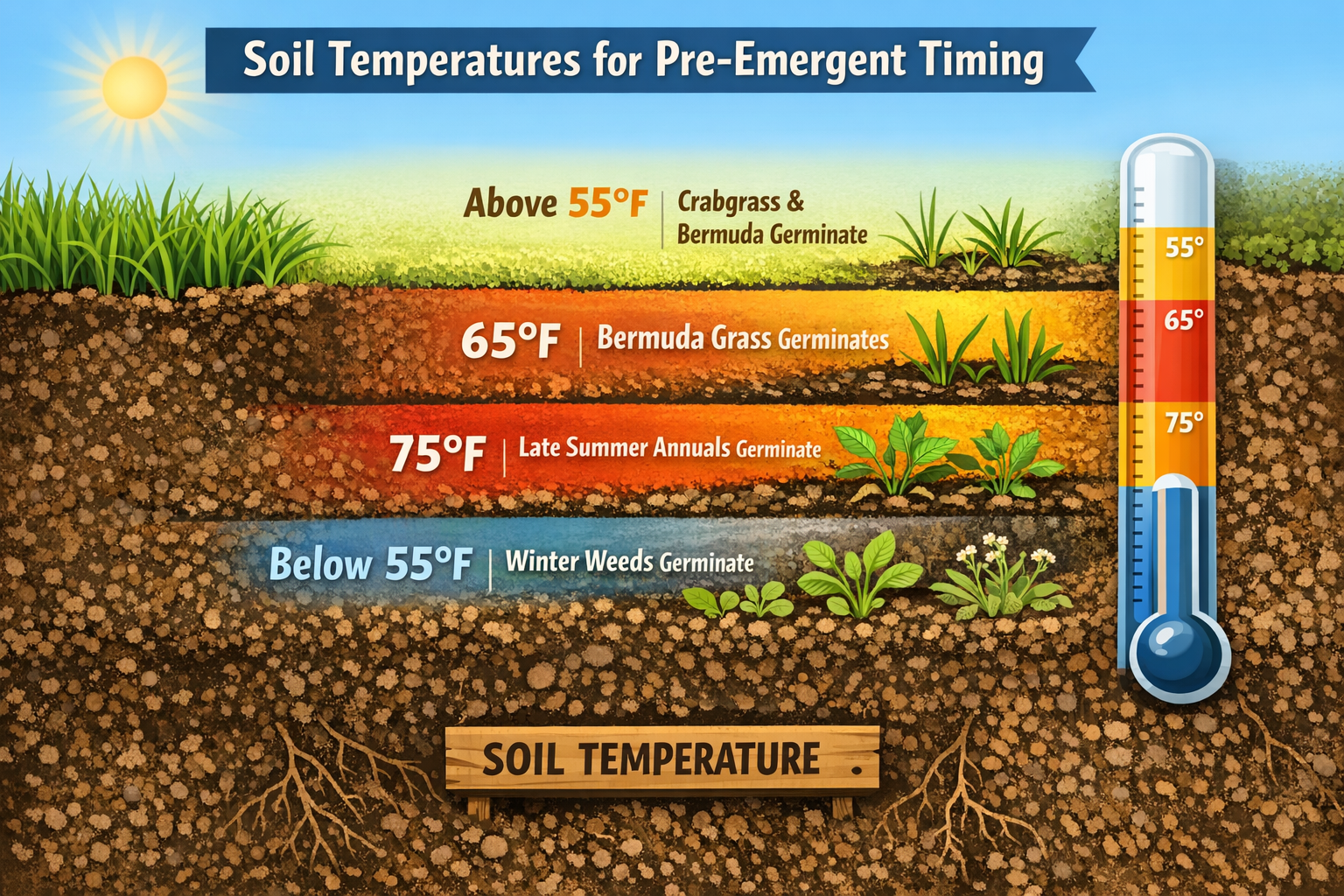
Soil Temperature & Weed Germination
Below 55°F
-
Winter annual weeds germinate
-
Examples: henbit, chickweed, annual bluegrass
Above 55°F
-
Summer annual weeds begin germination
-
Examples: crabgrass, goosegrass
Around 65°F
-
Bermuda grass begins active growth and germination
Above 75°F
-
Late summer annual weeds germinate
-
Heavier pressure and faster growth
Think of soil temperature as a switch. Once that switch flips, the pre-emergent window is closing or already closed.
One Key Reminder
Pre-emergent applications must be watered in with rainfall or irrigation. No water means no barrier. No barrier means weeds.
GRANULAR PRE-EMERGENT PRODUCTS
Andersons 11-3-11 w/ 0.86% Pendimethalin
-
Form: Granular fertilizer + herbicide
-
Rate: 5 lb per 1,000 sq ft
-
Coverage: 10,000 sq ft per 50 lb bag
-
Timing: Spring and fall
-
Strength: Broad annual grass control
-
Notes: Most popular all-around turf program
Pendimethalin 2G
-
Form: Granular herbicide only
-
Rate: 3 lb per 1,000 sq ft
-
Coverage: 13,000 sq ft per 40 lb bag
-
Timing: Spring and fall
-
Strength: Clean pre without fertilizer
-
Notes: Use when fertility is not needed
6-3-12 w/ 0.37% Prodiamine
-
Form: Granular fertilizer + herbicide
-
Carrier: Hu-Actinite
-
Rate: 6.25 lb per 1,000 sq ft
-
Coverage: 8,000 sq ft per bag
-
Timing: Early spring or fall
-
Strength: Long residual control
-
Notes: Stronger hold than pendimethalin
LIQUID PRE-EMERGENT PRODUCTS
Prodiamine 65 WDG (Quali-Pro)
-
Form: Water-dispersible granule
-
Rate:
-
0.38 oz per 1,000 sq ft (lighter pressure)
-
0.55 oz per 1,000 sq ft (heavy pressure)
-
-
Timing: Early spring or fall
-
Strength: Longest residual
-
Notes: Commercial backbone product
Pendimethalin HydroCap
-
Form: Liquid micro-encapsulated
-
Rate:
-
0.55–1.1 oz per 1,000 sq ft
-
-
Timing: Spring or fall
-
Strength: Consistent soil binding
-
Notes: Good alternative to granular programs
PROFESSIONAL-GRADE ADDITIONS
Barricade 4FL (Prodiamine)
-
Form: Liquid
-
Rate: 0.38 - 0.55 oz per 1,000 sq ft
-
Use: Large acreage, commercial turf
-
Strength: Long residual, flexible application
Dimension (Dithiopyr)
-
Form: Granular or liquid
-
Rate: Per formulation
-
Use: Slightly late applications
-
Strength: Early post-emergent activity on crabgrass
-
Notes: Shorter residual than prodiamine
Indaziflam (Esplanade / Specticle)
-
Form: Liquid or granular
-
Rate: Extremely low use rates (label specific)
-
Use: High-pressure commercial sites
-
Strength: Longest residual available
-
Notes: Not for casual homeowner use
Activation & Irrigation
-
Apply ½ - 1 inch of water within 7 - 10 days.
-
Rainfall can substitute if sufficient.
-
Do not mechanically disturb soil after application.
Common Mistakes
-
Applying after weeds are visible.
-
Skipping irrigation.
-
Using pre-emergent on newly seeded turf.
-
Overlapping applications causing root pruning.
Product: Agita 10 WG (thiamethoxam 10%) fly bait/insecticide
Application rate (from EPA & manufacturer label):
-
Mixing: 2.5 oz (75 g) Agita 10 WG in 20 oz (0.6 L) warm water. Stir until dissolved.
-
Coverage: This makes enough for about 2,125 sq ft of treated surface in spot applications.
-
Spot treatment: Paint or spray only about 30% of available surfaces where flies rest, sunny walls, around windows, door frames, and rafters.
-
Reapply: Every 4 - 6 weeks or sooner if treated areas are washed or heavily soiled.
Time of day for best results:
-
Apply early morning or late afternoon when flies are active but not in the peak midday heat (over ~95°F, flies often rest in shaded areas).
-
Morning applications let the bait dry before flies peak in activity, which usually occurs mid to late morning.
Longevity / Residual control:
-
Indoors: up to 6 weeks residual kill if surfaces remain dry and clean.
-
Outdoors: typically 2 - 4 weeks, shorter if rain, high humidity, or dust build-up occurs.
-
Flies begin dying within minutes to hours after contact/feeding.
Extra BMP tips:
-
Rotate with non–Group 4A products every season to reduce resistance risk.
-
Don’t apply to areas where animals can lick or touch it.
-
Avoid use where food/feed could be contaminated.
Mixing Instructions for One Acre Application
Using Esplanade 200 SC, Ranger Pro, and Diquat
- Product Rates per Acre
- Esplanade 200 SC (Pre-emergent): 5 to 7 fluid ounces
- Ranger Pro (41% Glyphosate): 2 to 3 quarts
- Diquat (37.3%): 1 to 2 quarts
- Example Mix for One Acre
- Esplanade 200 SC 6 oz
- Ranger Pro 2.5 quarts (80 oz)
- Diquat 1.5 quarts (48 oz)
- Mix into 40 to 80 gallons of water, depending on your sprayer output
- Coverage
- One acre = 43,560 square feet
- Typical application volume = 1 to 2 gallons per 1,000 sq ft
- That means you'll use 44 to 87 gallons of finished spray per acre
Fence Row Application
If spraying a fence row, measure 1 foot out on each side of the fence.
This creates a 2-foot wide band along the fence.
To calculate product needs:
- 1 mile of fence row (2 feet wide) = 0.24 acres
- Adjust your chemical mix based on this portion of an acre
- Example: Use about 1.5 oz Esplanade, 0.6 qt Ranger Pro, and 0.4 qt Diquat for 1 mile
Make sure to agitate the tank mix during application.
Spray evenly and avoid overlap for best results.
Let us know how we can help. We’re here to serve.
BES-TEX Supply • 4512 Adobe Dr. • San Angelo, TX 76903 • 325.653.1300 • www.BES-TEX.com
Here’s a complete and organized list of 20 each for Broadleaf, Grassy, and Sedge-type weeds, divided by summer and winter, common to Texas lawns:
Broadleaf Weeds in Texas
Summer Broadleaf Weeds (Warm-Season)
- Virginia Buttonweed
- Spurge (Prostrate & Spotted)
- Purslane
- Pigweed
- Carpetweed
- Ground Ivy
- Curly Dock
- Black Medic
- Burweed (stickerweed) – late spring
- Common Ragweed
Winter Broadleaf Weeds (Cool-Season)
- Henbit
- Chickweed
- Dandelion
- Clover
- Mallow
- Hairy Bittercress
- Wild Violets
- Shepherd’s Purse
- Thistle
- Deadnettle
Grassy Weeds in Texas
Summer Grassy Weeds (Warm-Season)
- Crabgrass
- Goosegrass
- Dallisgrass (perennial)
- Johnsongrass (perennial)
- Barnyardgrass
- Texas Panicum
- Sandbur
- Smutsgrass
- Foxtail (Setaria spp.)
- Crowfootgrass
- Liverseed Grass (Urochloa panicoides)
- Lovegrass
- Vaseygrass
- Sprangletop
- Carpetgrass (invasive in Bermuda/St. Aug.)
- Field Sandbur
- Signalgrass
- Itchgrass
- Woolly Cupgrass
- Junglerice (Echinochloa colona)
Winter Grassy Weeds (Cool-Season)
- Annual Bluegrass (Poa annua)
- Rescuegrass
- Ryegrass
- Cheatgrass
- Little Barley
- Downy Brome
- Tall Fescue (volunteer clumps)
- Wild Oats
- Canarygrass
- Volunteer wheat
- Volunteer oats
- Bromegrass
- Medusahead
- Jointed Goatgrass
- Rat-tail Fescue
- Soft Chess
- Roughstalk Bluegrass
- Slender Wildrye
- Velvetgrass
- Italian Ryegrass
Sedge and Sedge-Like Weeds (Warm-Season)
Most sedges are warm-season and thrive in wet, compacted soil.
- Yellow Nutsedge
- Purple Nutsedge
- Green Kyllinga
Let’s Talk About Sheaths, Seed Heads, and the Power of Nitrogen
If you’ve been looking close at your lawn lately, especially Bermuda and Zoysia, you’ve probably noticed tough little stalks poking up that aren’t just regular grass blades. Let’s dig a little deeper into what you’re seeing and how to help your lawn look its best.
Parts of the Grass Plant: What’s a Sheath Anyway?
Grass plants are made up of blades and sheaths. The blade is the flat green part we like to see. The sheath wraps around the base of the blade like a protective jacket. When your lawn starts pushing out seed heads, they come right through that sheath, and they’re often stiffer and lighter in color.
This is why your lawn might feel rough underfoot or look uneven even if you just mowed. It’s not growing crazy fast it’s pushing seed stalks, which grow taller and tougher than the leaf blades.
Why the Seed Heads Show Up
Like we talked about last week, seed heads are part of the plant’s natural cycle, often triggered by:
-
Warmer temps
-
Stress (like drought or compacted soil)
-
Not enough nitrogen
And here’s where fertilizer makes a difference.
Feeding Your Lawn Right: Let’s Talk Nitrogen
Nitrogen is the fuel your lawn needs to grow thick, green, and healthy. Without enough of it, grass gets pale, thin, and throws seed heads early.
Here are three solid options we recommend at BES-TEX:
-
16-8-8 + 5% Fe: Great balanced mix. Nitrogen for top growth, phosphorus for roots, and potassium for stress tolerance. Perfect for spring and early summer feedings.
-
21-7-14 + 5% Fe: Stronger nitrogen with a good kick of potassium to help the lawn handle heat and drought.
-
21-0-0 with 24% sulfur: Pure nitrogen boost with sulfur to help with high pH soils, which we see a lot of around San Angelo. Helps unlock nutrients your lawn might already have, but can't use.
Apply these when your grass is actively growing, and water it in well. That sheath we talked about? With the right nutrients, your grass will focus more on growing lush blades and less on going to seed.
Dad-to-Dad Tip: Think of fertilizer like breakfast for your lawn. Skipping it won’t kill it, but it won’t grow right either. Feed it well and mow it sharp. You’ll get a lawn that makes the neighbors take notice (and maybe get a little jealous).
Let us know how we can help. We’re here to serve.
BES-TEX Supply • 4512 Adobe Dr. • San Angelo, TX 76903 • 325.653.1300 • www.BES-TEX.com
Summer Fungus in Hybrid Bermuda Lawns
Hot days, humid nights, and regular watering perfect for hybrid Bermuda and summer lawn diseases. One of the most common in our area is Brown Patch (Rhizoctonia solani), but Pythium Blight and Leaf Spot can show up too.
How to Spot It
-
Brown Patch: Circular, tan/brown patches that seem to grow overnight. Often has a darker ring around the edge.
-
Pythium Blight: Slimy, matted turf in the early morning. Looks greasy.
-
Leaf Spot: Small, purplish spots on blades that lead to thinning turf.
What Causes It?
-
Nighttime watering or daily irrigation
-
High humidity or overwatering
-
Compacted soil with poor drainage
-
Too much nitrogen during hot weather
Let’s clarify: Overfertilizing means applying too much nitrogen in a single application. For example, 16-8-8 at 6.25 lbs/1,000 sq ft gives you 1 lb of nitrogen that’s a safe, effective rate every two weeks. But doubling that to 12.5 lbs/1,000 means 2 lbs of nitrogen at once and that’s when fungus problems start. Bermuda lawns still need 6+ lbs of nitrogen per year, but apply it gradually.
Prevention Tips
-
Water early morning only
-
Mow with sharp blades at 1.5–2 inches
-
Avoid high-nitrogen fertilizer in peak heat
-
Improve airflow (prune nearby trees or shrubs)
Products That Help
1. Heritage G (Azoxystrobin)
-
Mode of Action: Prevents fungal respiration, stopping disease before it spreads
-
Use: Granular, apply monthly as a preventative
2. Pillar G (Triadimefon + Trifloxystrobin)
-
Mode of Action: Dual-actio one stops fungal growth, the other prevents spore production
-
Use: Great for active infections fast knockdown
3. Armada 50 WDG (Trifloxystrobin + Tebuconazole)
-
Mode of Action: Systemic and contact gives curative and preventive punch
-
Use: Mix and spray, rotate with other fungicides to reduce resistance
4. Propiconazole (Banner Maxx)
-
Mode of Action: Inhibits fungal cell membrane production, stopping the fungus from growing
-
Use: Great for long-lasting control applied every 2-4 weeks during the summer months for disease prevention
If You Already Have It…
-
Treat infected areas early, before it spreads
-
Use a curative fungicide (like Pillar G or Armada)
-
Avoid watering in the evening
-
Bag clippings to reduce spread
If you're unsure what you're seeing, bring us a picture or a sample. We'll help you ID the problem and recommend the right treatment plan.
BES-TEX Supply has the fungicides, fertilizers, and real-world advice to keep your lawn looking sharp. Questions? Come see us at 4512 Adobe Dr. or call 325.653.1300.
Mosquito Control Tip
Larval Control (Targeting immature mosquitoes in water)
-
Mosquito Dunks (SUMMIT) 10.31% Bti
Mode of Action: Bti is a naturally occurring soil bacterium that releases protein toxins, killing mosquito larvae upon ingestion.
Use: Place in standing water, ponds, birdbaths, rain barrels. Each dunk treats 100 sq. ft. of water for up to 30 days. -
Altosid Pro-G IGR (ZOECON) 1.5% Methoprene
Mode of Action: Methoprene is an insect growth regulator (IGR) that mimics juvenile hormone, preventing larvae from maturing into adults.
Use: Apply granules to water-holding areas such as ditches, troughs, and containers. Controls for up to 30 days. -
Altosid Liquid Larvicide (ZOECON) 5% Methoprene
Mode of Action: Same as above but in liquid form, offering precision in smaller or treated urban areas.
Use: Mix with water and apply to known breeding sites using a sprayer. -
IN2CARE Bait Sachets 74.03% Pyriproxyfen, 10% Beauveria bassiana
Mode of Action: Dual action Pyriproxyfen is an IGR, Beauveria is a fungus that infects and kills adult mosquitoes.
Use: Place sachets inside IN2CARE traps; mosquitoes spread the active ingredients to breeding sites.
Trap-Based Control
-
INZECTO Mosquito Trap (INZECTO)
Mode of Action: A slow-release formulation containing larvicide and adulticide. Kills both larvae and females entering the trap.
Use: Set the trap in shaded, moist areas. Replace every 90 days. -
Mosquito Barrier 2-Pack (AION) Yeast-Based Lure
Mode of Action: Produces CO₂ via fermentation to attract female mosquitoes for targeted bait station deployment.
Use: Activate and place around perimeters, ideal for monitoring and reducing populations.
Adult Control (Targeting flying mosquitoes)
-
Cyonara Lawn & Garden (CONTROL SOLUTIONS) 0.05% Lambda-Cyhalothrin
Mode of Action: Pyrethroid neurotoxin, causes paralysis and death upon contact.
Use: Apply with a pump or hose-end sprayer to lawn, shrubs, and outdoor perimeters. -
Suspend PolyZone (BAYER) 4.75% Deltamethrin
Mode of Action: Microencapsulated pyrethroid, provides long residual kill of adult mosquitoes.
Use: Apply to shaded resting areas, under decks, foliage, walls. Rain-resistant. -
Bifen I/T (CONTROL SOLUTIONS) 7.9% Bifenthrin
Mode of Action: Broad-spectrum pyrethroid—disrupts nervous system function.
Use: Mix and spray on lawns, shrubs, and surfaces where mosquitoes rest. -
Malathion (CONTROL SOLUTIONS) 57% Malathion
Mode of Action: Organophosphate, blocks acetylcholinesterase, leading to mosquito death.
Use: Apply only in outdoor, non-edible plant areas. Strong odor, use with caution. -
Permethrin 10% (CONTROL SOLUTIONS)
Mode of Action: Contact insecticide, quick knockdown via nerve disruption.
Use: Dilute and apply as barrier spray to tall grass, fences, and patios. -
Mosquito Pro RTS (MARTIN’S) Lambda-Cyhalothrin, Novaluron, Pyriproxyfen
Mode of Action: Combines knockdown, IGR, and residual control, targets multiple stages.
Use: Ready-to-spray bottle connects to hose for easy perimeter treatment.
Aerosol Space Sprays (For immediate knockdown)
-
Pystol Farm & Dairy Aerosol (MARTINS)
Mode of Action: Dual-action pyrethrins + permethrin with PBO to enhance efficacy.
Use: Spray directly in barn, shed, or outdoor sitting area. Use with caution around pets. -
565 Plus XLO (BASF)
BES-TEX Supply • 4512 Adobe Dr. • San Angelo, TX 76903 • 325.653.1300 • www.BES-TEX.com
Mode of Action: Synergized pyrethrin with PBO and Bicycloheptene for quick indoor/outdoor knockdown.
Use: Spot treatment for resting mosquitoes, porches, patios, or inside storage sheds.Let us know how we can help. We’re here to serve.
Best Management Practices (BMP) for Grub Control in San Angelo, TX
May Edition: The Grubs Are Lurking, But Should We Be Worried?

First, What Is a Grub?
Grubs are not a specific insect, they're the larval stage of several beetles. Think of them as the awkward teenage phase of the beetle world. Common culprits in our West Texas turf include:
-
June Beetles (aka May beetles, calendar confusion aside, they’re active spring to summer)
-
Masked Chafers
-
Occasional Japanese Beetles (less common here, but worth watching)
Life Cycle Breakdown
-
Adults emerge (late spring/early summer) and lay eggs in the soil.
-
Eggs hatch into C-shaped, white-bodied grubs that feed on grassroots.
-
Feeding frenzy continues through fall, then they burrow down to overwinter.
-
Spring warm-up brings them back up briefly before pupating and turning into beetles.
In short: they hide, they chew, they cost you money.
How Many Grubs Is Too Many?
The economic threshold is:
-
0–5 grubs/sq ft: No sweat.
-
6–9 grubs/sq ft: Keep an eye out.
-
10+ grubs/sq ft: Time to suit up and fight back.
That’s the point when you’ll notice patches of turf rolling back like a rug, thanks to root damage.
Control Options, Chemical Edition
Two main players are effective when applied at the right time:
-
Imidacloprid (Merit® and similar): Best as a preventative, applied in May–June. Gets absorbed by roots and zaps grubs when they snack.
-
Chlorantraniliprole (Acelepryn®): Low-risk for pollinators, long-lasting, and works great in May.
Modes of Action
-
Imidacloprid: Blocks neural pathways. Grubs stop feeding and check out permanently.
-
Chlorantraniliprole: Affects calcium flow in muscles. Basically paralyzes them slowly and permanently.
Grub Pressure in San Angelo A History Lesson
Grub issues spike after wet springs, especially following drought years when beetles get active. However, recent seasons have shown low activity in San Angelo. Low rainfall and hot soil temps may be keeping beetle populations in check. Still, better to scout than be sorry.
BMP Takeaways
-
Scout now (first week of May) and again mid-summer.
-
Treat preventatively if you had past damage or high beetle activity.
-
Don’t overtreat grubs aren’t always the bad guys.

Need help picking the right product or identifying grub species?
Come see us at:
BES-TEX Supply
4512 Adobe Dr., San Angelo, TX 76903
325.653.1300
www.BES-TEX.com
Your turf deserves better than a mouthful of beetle babies.
-
TifTuf:
-
TifTuf has a denser growth pattern with nodes (sprigs) spaced approximately every ¼ inch along its stolons (runners). This tight spacing results in a thick, lush turf that fills in quickly, leaving less room for weeds to penetrate.
-
It is known for faster establishment and recovery from injury due to its extensive root system and dense growth.
-
-
Tifway 419:
-
Tifway 419 has nodes spaced every ½ to 1 inch, which is less dense than TifTuf but still tighter than common Bermuda grass (1-3 inches). This makes it less compact compared to TifTuf but still suitable for high-traffic areas.
-
It establishes well but may take slightly longer to fill in compared to TifTuf.
-
-
TifTuf:
-
Typically exhibits a light green color, though opinions vary on whether it’s lighter or slightly darker than Tifway 419. Some sources note it holds color longer into the fall and greens up earlier in the spring.
-
With heavy nitrogen and iron fertilization, its color can deepen significantly, potentially matching or exceeding Tifway 419 in vibrancy.
-
-
Tifway 419:
-
Known for a deep emerald green color, which is often described as visually striking.
-
However, it may require more fertilization to maintain this rich color compared to TifTuf, especially in less-than-ideal conditions.
-
-
TifTuf:
-
Superior drought resistance due to its extensive root system, requiring less water than Tifway 419.
-
Improved shade tolerance compared to other Bermuda varieties, though it still prefers full sun. It can handle partial shade better than Tifway 419.
-
Greens up earlier in spring and stays green longer in fall, extending its active growing season.
-
-
Tifway 419:
-
Drought and heat resistant, but not as efficient as TifTuf in water conservation. It was selected for its performance in South Texas, where heat and drought are common, but TifTuf outperforms it in extreme conditions.
-
Less shade-tolerant, requiring more sunlight to thrive compared to TifTuf.
-
-
TifTuf:
-
Requires less frequent watering and fertilization due to its drought resistance and efficient growth.
-
Needs regular mowing (every 4-5 days) at a height of ½ to 1.5 inches to maintain its dense, healthy appearance. Infrequent mowing (e.g., every two weeks) can lead to thinning and a scalped look.
-
Its aggressive growth makes it easier to maintain under neglect compared to other Bermuda varieties.
-
-
Tifway 419:
-
Requires more fertilization to maintain its color and density, especially in high-traffic or shaded areas.
-
Like TifTuf, it benefits from frequent mowing (every 4-5 days) at a similar height to avoid thinning or a wiry appearance.
-
Can look stringy or grayish without adequate care, particularly in suboptimal conditions.
-
-
TifTuf:
-
Often marketed as a “super grass” due to its toughness and low maintenance, making it ideal for home lawns, sports fields, and golf courses.
-
Generally more affordable to produce and purchase because of its ease of farming and fast growth.
-
-
Tifway 419:
-
Originally developed for golf course fairways, it’s widely used for lawns and sports fields due to its durability and aesthetic appeal.
-
Historically, it was more expensive due to a patent, but since the patent expired, it has become more accessible for homeowners and builders.
-
-
TifTuf:
-
Widely available through suppliers like SuperSod, especially in regions like the southeastern U.S. It’s actively promoted as a newer, improved variety.
-
-
Tifway 419:
-
Also widely available, especially in South Texas and other southern regions, but may be less common in some areas compared to TifTuf due to the latter’s rising popularity.
-
-
Choose TifTuf if you want a low-maintenance, drought-resistant, and shade-tolerant Bermuda grass with fast establishment and a slightly lighter green color that can be enhanced with fertilization. It’s ideal for homeowners seeking a resilient, cost-effective lawn.
-
Choose Tifway 419 if you prioritize a deep emerald green color and are willing to invest more in fertilization and maintenance. It’s well-suited for high-end lawns or golf courses where aesthetics are paramount.
-
Both require frequent mowing to maintain density and avoid thinning, but TifTuf’s superior environmental tolerance and lower input needs make it a more modern, practical choice for many applications.