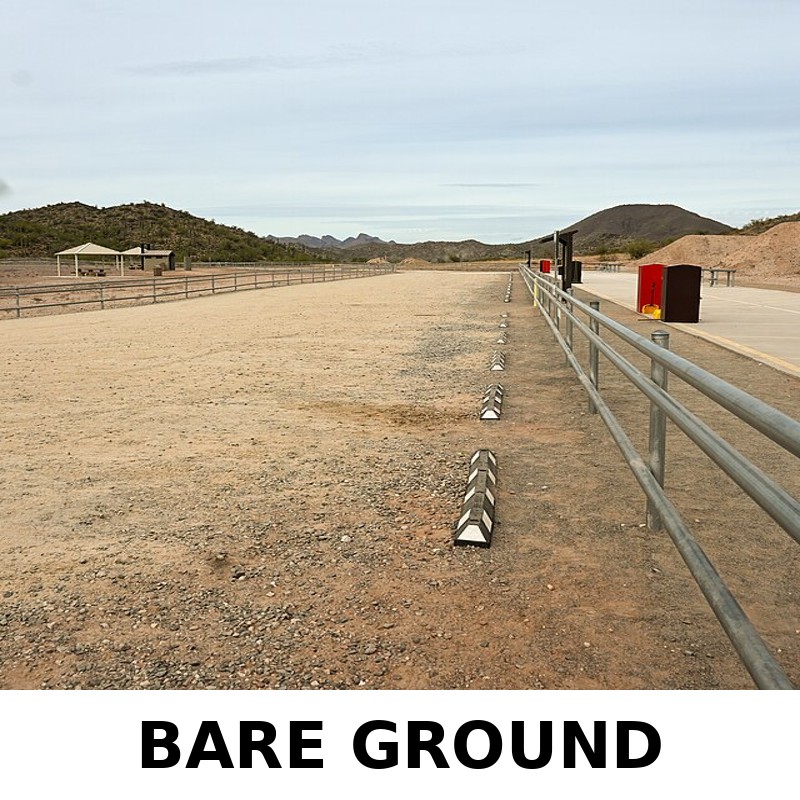
Brush - Bare Ground - Bare Ground
Bare Ground (Total Vegetation Control) for West Texas
Gravel lots, fence lines, around buildings, parking areas, equipment yards, utility areas. Kill what is there, then keep new weeds from coming up.
What Bare Ground Is
Bare ground means no plants at all on the treated area. It is used for fire safety, clean lines of sight, weed-free gravel and a neat look. It is a two-part job:
- Burndown kills weeds you can see now (Ranger Pro, diquat).
- Residual pre-emergent stops new weeds from seed (Esplanade 200 SC).
Esplanade alone will not kill weeds that are already up. Ranger Pro and diquat alone will not stop new weeds. You need both.
When to Use It (and When Not To)
- Use only on non-crop sites: gravel lots, fence rows, around farm and commercial buildings, parking lots, utility and storage areas.
- Esplanade 200 SC label: "Do not use on residential lawns, golf courses, sod farms, or production and landscape ornamentals."
- Paved areas: Esplanade label says "Applications to hardscapes (e.g. patios, paved parking lots, and walkways) may be made by spot application only."
- Not for areas you plan to seed or plant soon. Not for pasture you plan to graze.
The Tank Mix (BES-TEX Standard)
From BES-TEX's BMP Using Esplanade 200 SC, Ranger Pro, and Diquat:
| Product | Role | BES-TEX BMP rate per acre | Label rate (cited) |
|---|---|---|---|
| Esplanade 200 SC (indaziflam), EPA Reg. No. 432-1516 | Residual pre-emergent | 5 to 7 fl oz | "Apply Esplanade 200 SC at 5-7 fl oz per acre." Bareground section. Label |
| Ranger Pro (41% glyphosate), EPA Reg. No. 524-517 | Systemic burndown | 2 to 3 quarts | Annual weeds: "Use 1 quart per acre if weeds are less than 6 inches in height or runner length and 1.5 quarts to 4 quarts per acre if weeds are over 6 inches..." Label |
| Diquat 37.3% (label used: Nufarm diquat, EPA Reg. No. 228-675) | Fast contact burndown | 1 to 2 quarts | Industrial broadcast: "1-2 pts. of this product per acre plus a nonionic surfactant". Spot spray: "1-2 qts. ... per 100 gals. water". Label |
Review note: the BMP lists diquat at 1 to 2 quarts per acre, but the diquat label broadcast rate is 1 to 2 pints per acre (1 to 2 quarts is per 100 gallons for spot spraying). The tables below use the label pint rate.
Mixing Chart
Assumed spray volume: 40 gallons per acre (about 0.92 gal per 1,000 sq ft). This fits every label: Esplanade "10-100 gallons per acre", Ranger Pro ground broadcast "3 to 40 gallons of water per acre", diquat broadcast "a minimum of 15 gallons of water per acre" (diquat label, noncrop farm areas). Rates used: Esplanade 6 fl oz, Ranger Pro 2.5 qt (80 fl oz), diquat 1.5 pt (24 fl oz) per acre.
Math: product per acre / 40 gal = product per gallon. Esplanade 6 / 40 = 0.15 fl oz. Ranger Pro 80 / 40 = 2.0 fl oz. Diquat 24 / 40 = 0.6 fl oz.
| Product | 1 gal | 3 gal | 15 gal | 25 gal | 1 acre (40 gal) |
|---|---|---|---|---|---|
| Esplanade 200 SC | 0.15 fl oz (about 4.4 mL) | 0.45 fl oz | 2.25 fl oz | 3.75 fl oz | 6 fl oz |
| Ranger Pro | 2.0 fl oz | 6.0 fl oz | 30 fl oz | 50 fl oz | 80 fl oz (2.5 qt) |
| Diquat 37.3% | 0.6 fl oz | 1.8 fl oz | 9 fl oz | 15 fl oz | 24 fl oz (1.5 pt) |
| Nonionic surfactant (75%+) | Per surfactant label | ||||
The chart only works if the sprayer actually puts out 40 gallons per acre (about 0.92 gal per 1,000 sq ft). Calibrate first. If you spray more water per area, you are putting out more product per acre. Never go over: Esplanade 7 fl oz per acre per application.
Fence row: per the BES-TEX BMP, a 2-foot band (1 foot each side) for 1 mile = 0.24 acres.
Mixing order (Esplanade label): fill tank half full with water, add Esplanade 200 SC, then the rest of the water, keep agitating. Label order for tank mixes: water-soluble packets, WP, WG/dry flowables, fertilizers, Esplanade 200 SC, then other liquids. Do a jar test first. Shake Esplanade well before using; it settles.
Timing for the Concho Valley
- Esplanade label: "Apply Esplanade 200 SC prior to weed seed germination." "Apply ... in the spring for control of spring and summer germinating weeds and apply in the fall for control of winter weeds."
- BES-TEX pre-emergent windows (Pre-Emergent BMP): February, May, September.
- Rain activation: Esplanade "requires rainfall (minimum 0.25 inches) within several weeks after application to activate the herbicide." No rain, no barrier.
- But do not spray right before a storm: "Runoff of this product will be reduced by avoiding applications when rainfall is forecasted to occur within 48 hours." (Esplanade label)
- Burndown works best on young, actively growing weeds. Diquat label: "Do not apply to weeds that are growing under stress." Ranger Pro label: "Reduced results may occur when treating weeds heavily covered with dust." In a dry West Texas summer, burndown results drop.
- Ranger Pro label: "Heavy rainfall soon after application may wash this product off of the foliage and a repeat application may be required."
How to Spray
- Ground equipment only. Esplanade: "Do not apply by air." Backpack and hand-held are allowed; label says rates per area are the same as a boom.
- Coarse droplets, low pressure, low boom, spray when wind is low (Esplanade label). Ranger Pro label: "Drift potential is lowest between wind speeds of 2 to 10 miles per hour."
- Even coverage, no overlap. Do not spray foliage to the point of runoff (Ranger Pro label).
- Leave treated soil undisturbed (Esplanade label). Do not blade or drag gravel after treating.
Cautions (Read Before You Spray)
- Trees and shrubs: Ranger Pro: "AVOID CONTACT OF HERBICIDE WITH FOLIAGE, STEMS, EXPOSED NON-WOODY ROOTS OR FRUIT OF CROPS, DESIRABLE PLANTS AND TREES." Esplanade: "Do not apply or otherwise permit this product or sprays containing this product to come into contact with any non-target crop or desirable plants." Stay off the root zone of trees you want to keep.
- Water: Esplanade: "Do not apply directly to water or to soil where standing water is present." "Do not apply in or on irrigation ditches/canals including the outer banks." Ground Water Advisory: "may leach into ground water if used in areas where soils are permeable, particularly where the water table is shallow."
- Runoff and slopes: Esplanade: "Applications made to areas where runoff water flows onto agricultural land may injure crops." "Applications made during periods of intense rainfall, to soils saturated with water, or soils through which rainfall will not readily penetrate may result in runoff." Watch where water runs off a lot or slope.
- Livestock: Esplanade: "Do not graze or feed forage, hay, or straw from treated areas to livestock."
- Concrete: Diquat label: "Do not exceed the labeled rate of this product or concrete-based materials will be stained."
- Re-entry: Ranger Pro REI 4 hours; diquat REI 24 hours (agricultural use, per labels).
- PPE: Esplanade handlers: long-sleeved shirt, long pants, shoes plus socks, and waterproof gloves. Check each label.
Re-Treatment and Yearly Limits
- Esplanade: "A repeat application can be made but not to exceed a total amount of 10 fl oz per acre per year." "Do not exceed 7 fl oz per acre ... in a single application."
- Ranger Pro: "Repeated applications of this product may be used, as weeds emerge, to maintain bare ground." Yearly cap: "must not exceed 10.6 quarts of this product (10.6 pounds of glyphosate acid) per acre per year."
- Diquat: "Retreatment may be necessary to control grasses and established weeds."
- Esplanade "does not control tubers, rhizomes, and woody vegetation." Spot-spray escapes with Ranger Pro.
Expectations (Set This Straight at the Counter)
- Diquat browns weeds fast. Diquat label: "within 24-36 hours."
- Ranger Pro is slower but kills roots. Label: effects "visible on most annual weeds within 2 to 4 days."
- Esplanade works quietly in the soil after rain. You judge it by what does not come up.
- Bare ground is a program, not one spray.
Read and follow the full label for every product. The label is the law.
BES-TEX Supply, 4512 Adobe Dr., San Angelo, TX 76903, 325.653.1300, www.BES-TEX.com